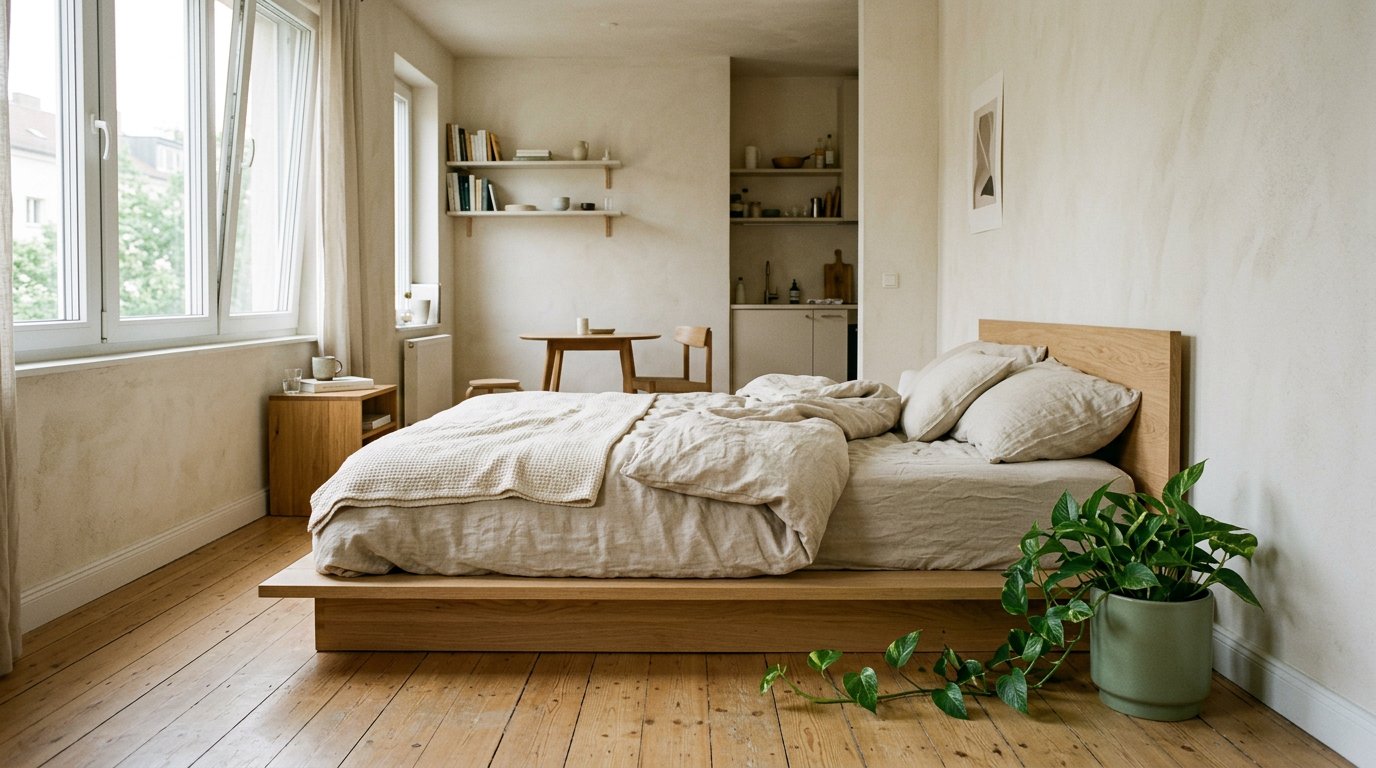
There’s a specific kind of apartment envy I used to feel scrolling through interior design accounts.
Not the kind sparked by sprawling open-plan spaces or professionally styled rooms, but the kind that comes from seeing a 400-square-foot studio that somehow looked calm. No clutter. No visual noise. Just a low wooden bed frame, a linen throw, a single plant catching the light.
That aesthetic has a name: Japandi. And the longer I’ve lived in small spaces, the more convinced I am that it wasn’t designed for big ones.
What Japandi really is (and isn’t)
Japandi is a blend of Japanese and Scandinavian design ideas, two traditions that, on the surface, seem to come from completely different worlds One is rooted in the Japanese philosophy of wabi-sabi to locate splendor in imperfection and impermanence.
The other is built around hygge, the Danish idea of comfort and contentment in everyday life. Put them together and you get something with minimal heat each. If you’ve ever tried to make a small rental experience livable, and not just “spartan,” you’ll realize that balance is exactly what you’re looking for
What is not Japandi is pure. This is the error most humans try to recreate the first time. They take everything apart, paint the partitions white, and end up making the area feel more like a ready room than a house. True Japandi has the texture. It has warmth. There’s just no extra.
Start with Color: Muted, not Boring
The Japandi palette has a tendency to sit on a thin band of earthy, desaturated tones. Think thermal whites, smooth greys, sage greens, dusty terracottas, and the kind of browns that turn to driftwood rather than chocolate. Nothing jarring. Nothing competes.
In a small apartment that is honestly a practical gift. A cohesive shadow story makes the space feel large because your eye can roam around the room non-stop. There’s no hot purple accent wall appeal to the corner that you’ll alternatively neglect approximately.
If you rented and can’t picture, what you got are pictures. A warm beige or off-white wall is already close to perfect. If your partition is vivid white, rely on warm fabrics and wood tones to soften things up. If you’re caught up in something extra unfortunate (the builder’s beige long slightly yellowish, or the previous tenant’s ambitious preference), a large piece of art in muted tones or a floor-to-ceiling curtain in natural linen can do more than you’d imagine to reset the visual baseline of the room
Budget Option: An unmarried can of paint in a soft warm white or sage look holds little to no prices and makes a complete difference. If you can paint one wall most effectively, paint the wall behind the bed or couch. That sets the tone.
Furniture: Low, Simple, and Built to Last
Japanese interiors historically sit towards the ground. Low furniture not only creates a visual breathing room in a small area (more walls looking way up reads room taller), additionally conveys a form of groundedness that’s very typical for Japandi A low loft mattress, a coffee table that sits at shin height, ground cushions layered over a natural fiber rug: that’s it Construction blocks.
You don’t need to shop a whole lot new. In truth, hunting thru secondhand stores is very much in the spirit of this beauty. The Japandi are quick to value craftsmanship and rigor over furnishings, so a solid wood sided table from a charity store will serve you better than a flat-% occasion, even if a touch refinish is involved.
What to look for: Clean strains, herbaceous materials (wood, bamboo, rattan, stone, linen, cotton, wool), and pieces that don’t try too hard. Avoid ornate engraved legs, decorative accessories, and anything that looks like it has a story to suggest on it. Japandi furniture is quiet. It exists to help the living life around it, not to draw interest to itself.
For tight budgets: IKEA’s LACK tables, the HEMNES series, and the SINNERLIG variety certainly work right here. They’re minimalist, they come in natural tones, and they’re affordable. The trick is how you style them around (a rattan tray, a candle, a small ceramic dish) as opposed to what the furniture is.
The "Little but Good" Approach to Stuff
This is where most people battle, because it is no longer about anything undoubtedly approximately designed. It’s presumably changing.
Japandi spaces generally follow a precept this is close to the German idea of weniger aber besser: lower, yet higher. Each object earns its own area. If something is practical, it has to be nice too. If it’s decorative, it may be important. Everything else should go in a drawer, basket, or donation pile.
In a small rental this is not always just aesthetically pleasing. It is important. Visual clutter in a small area doesn’t just look cluttered; it makes the walls feel like they’re shifting in. The Japandi technique of displaying just a few thoughtful objects (homemade ceramics, a branch of a sudou vase, a small stack of books) provides somewhere to focus on comfort without overwhelming it.
A sensible approach: do it one room at a time. Completely clean a floor, then best return the item you would be happy to photograph. Leave the rest in a container for two weeks. If you don’t go looking for something at that point, you probably don’t want it out.
Lighting: Soft, Layered, Intentional
A small apartment has a light on the enemy of its surroundings. An unmarried ceiling bulb, but bright, flattens everything out and makes the room feel like the studio you work in as opposed to the house you live in.
Japandi lights are low, warm and layered. Paper lanterns (Muji and IKEA each do lower priced versions that are really accurate), small ceramic desk lamps, ground lamps with linen sunglasses, candlelight. The goal is swimming pools of thermal light against a uniform glow.
If you can only do one component: switch any cool-white bulb for a decent white bulb (2700K is ideal). It’s a few bucks in step with bulb and it’s going to transform the sensation of your rent greater than almost any unmarried design choice.
Budget Split: What to Prioritize
If you work with limited funds, going back to one type of investment is not always the same. Here’s roughly how I’d think an idea on it:
Highest impact, lowest cost: light fixture bulbs, some natural fabrics (a linen throw, a jute rug), and additions to what you already have. You can dramatically shift the feel of a room without having to shop for a brand-new piece of furniture, simply by removing items that aren’t in shape and rearranging what’s left.
Moderate investment, large to go back to: one or fine secondhand fixture pieces in herbwood, a larger plant in a simple ceramic pot, desirable outstanding linen curtains.
Worth saving up for: A loft mattress body or low sofa if your current day one runs against you. These are the anchor parts that make or break the look, and it’s really worth it to be prepared to get something right instead of investing.
One Final Note on Imperfection
One of the things that I’ve definitely come to appreciate about the Japandi and Japanese design culture is that it deals with imperfection. A bowl with an odd rim. Linen cushions that sit on you and wrinkle. A plant that grows sporadically in the direction of a window.
These are not errors that need to be corrected. They are proof of real existence living in a real realm.
Small apartments are, in some ways, impeccably placed for this. Not enough room to make everything better. The lighting may not always be flattering, the furnishings may not consistently fit perfectly, and one’s footwear may not necessarily be somewhere.
The Japanese makes peace with her. It creates a kind of graceful reputation that makes imperfection a part of warmth instead of a problem to be solved.
That, in addition to any specific furniture or color palette, is what makes it feel like home.