A small Japandi kitchen is one of the most searched things on home decor blogs right now, and yet almost every result shows the same thing: custom oak cabinetry, stone countertops, integrated appliances, and a backsplash that cost more than three months of rent.
If you are a renter standing in your tiny apartment kitchen staring at beige laminate cabinet doors, a scratched counter, and tiles that look like they were chosen in 1994 by someone who had genuinely given up, those results are not for you.
They are for people renovating. You are not renovating. Your landlord has made that very clear.
Here is the thing though. Japandi was never really about the fittings. It was never about the material the cabinets are made from or whether the countertop is solid stone. Japandi is a philosophy built from two very specific ideas.
From Japan, it borrows wabi-sabi, which is the belief that beauty lives in simple, imperfect, honest things. From Scandinavia, it borrows hygge, which is the idea that a space should feel warm, functional, and genuinely good to be in every single day.
Neither of those ideas requires a renovation budget. Neither requires permission from a landlord. And neither has anything to do with how much the kitchen cost to fit out.
So this post is not for the person planning a kitchen remodel. This is for the renter with a tiny apartment kitchen makeover problem, a no-renovation restriction, and a genuine desire to cook in a space that feels calm instead of chaotic.
By the end, you will have a surface-by-surface plan that works entirely within what rental life allows, costs a fraction of what those inspiration posts suggest, and produces a kitchen that actually looks and feels like somewhere a person chose to be.
What Japandi Actually Means in a Kitchen — and Why It Suits Rentals Better Than You Think
Before getting into the practical changes, it helps to understand something that most Japandi content skips over completely. Traditional Japanese domestic kitchens were small. Often very small. Fixed fittings, limited equipment, minimal storage, not much natural light. Sound familiar?
The Japanese approach to cooking spaces was shaped by centuries of working with exactly what was available, not what was ideal. The beauty in those kitchens came from editing, not from upgrading.
From the quality and intention behind the few objects present, not from the price of the surfaces they sat on. A handmade ceramic bowl on a worn wooden counter in a tiny Tokyo apartment is more Japandi than a custom walnut kitchen with forty-seven objects lined up on the counter in a colour-coordinated row.
This matters because it completely changes the strategy. Instead of asking what you need to buy or install, the Japandi question is: what needs to come off the counter, out of sight, and out of the way? What three objects should stay visible because they are genuinely used and genuinely beautiful?
What material, even a cheap or fixed one, can be made to look intentional with the right light and the right things placed beside it?
Three principles hold the entire approach together regardless of what the rental kitchen looks like underneath. First, calm surfaces: clear, uncluttered, consistent in tone. Second, intentional objects: only what is used regularly and chosen with some care for how it looks.
Third, warm natural accents: wood, terracotta, linen, ceramic — at least one of these present in every visible zone of the kitchen. With those three principles working together, even the most landlord-beige kitchen starts to shift.
Start With the Countertop — It Is the One Surface You Fully Own
The countertop is where the Japandi kitchen transformation actually begins, because it is the surface you have the most control over regardless of what the rental agreement says. You do not need to change the material or cover it. You just need to change what sits on it and how much of it remains visible.
Most rental kitchen counters carry far too much. A toaster, a kettle, a knife block, a fruit bowl overflowing with things that are not fruit anymore, some random sachets, a bottle of washing up liquid in a colour that clashes with everything, possibly a coffee machine the size of a small car.
Every object on that counter is a piece of visual noise. Together they make the counter feel busy, the kitchen feel small, and the whole room feel harder to be in than it needs to be.
The Japandi countertop rule is straightforward: keep only the three to five things you use every single day. Everything else lives in a cupboard. This does not mean getting rid of anything. The toaster is still there, just inside a cabinet. The kettle comes out when needed and goes back. What remains on the surface is a short list of objects that earn their visible presence.
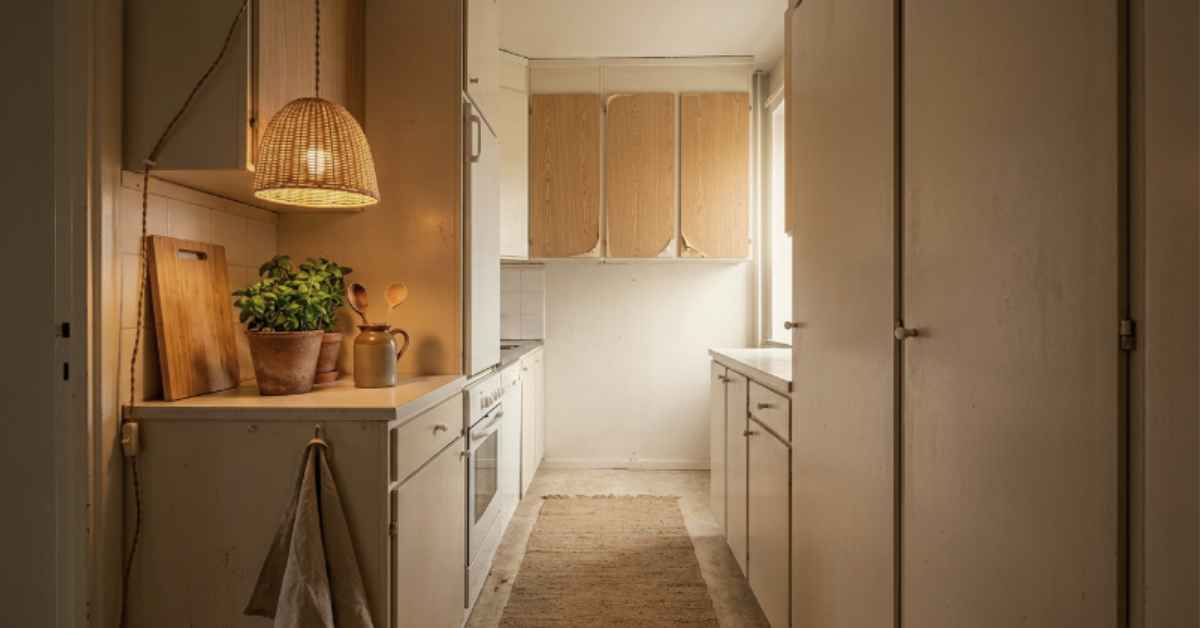
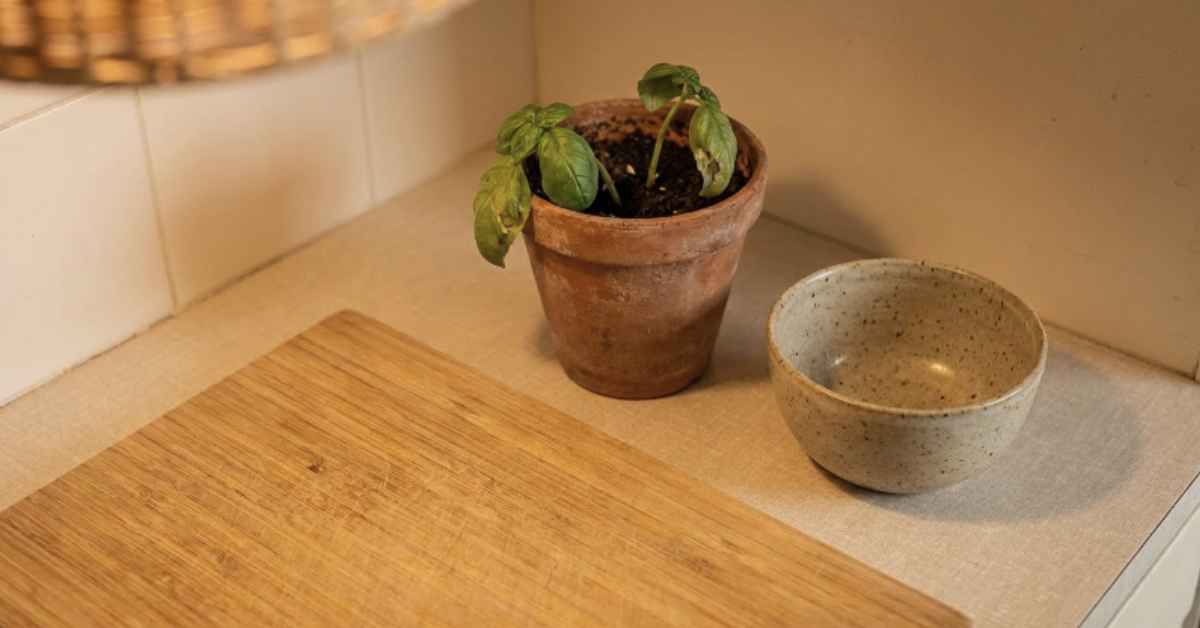
The three objects that carry the Japandi feeling on almost any countertop, regardless of the material underneath, are these. A light wood chopping board in oak or bamboo, standing upright against the backsplash or lying flat.
One ceramic or stoneware vessel, which could be a simple jug holding utensils, a small bowl, or a mortar and pestle. And one living thing, ideally a herb plant in a rough terracotta pot on the windowsill or at the edge of the counter nearest the light. That combination of natural wood, handmade ceramic, and something living does more for the Japandi reading of a kitchen than any cabinet change.
For counters that are genuinely damaged or in a material that makes everything else look worse, removable wood-grain or stone-look contact paper applied over the surface is a renter-friendly option that is reversible, affordable, and visually significant. Light oak grain or warm greige matte finishes work best because they have enough warmth in their undertone to carry the Japandi palette without looking like a craft project.
The Cabinet Problem – Working With Fixed Doors You Cannot Paint or Replace
This is the section every other Japandi kitchen post skips, because every other Japandi kitchen post was not written for renters.
The cabinet problem is real. Beige laminate doors, dark wood doors from a decade that no longer exists, white doors with yellow nicotine undertones, or that particular shade of cream that is somehow worse than any of the above.
Most rental agreements prohibit painting them. Replacing them is usually out of the question. So here is what actually works.
Peel-and-stick contact paper on cabinet fronts
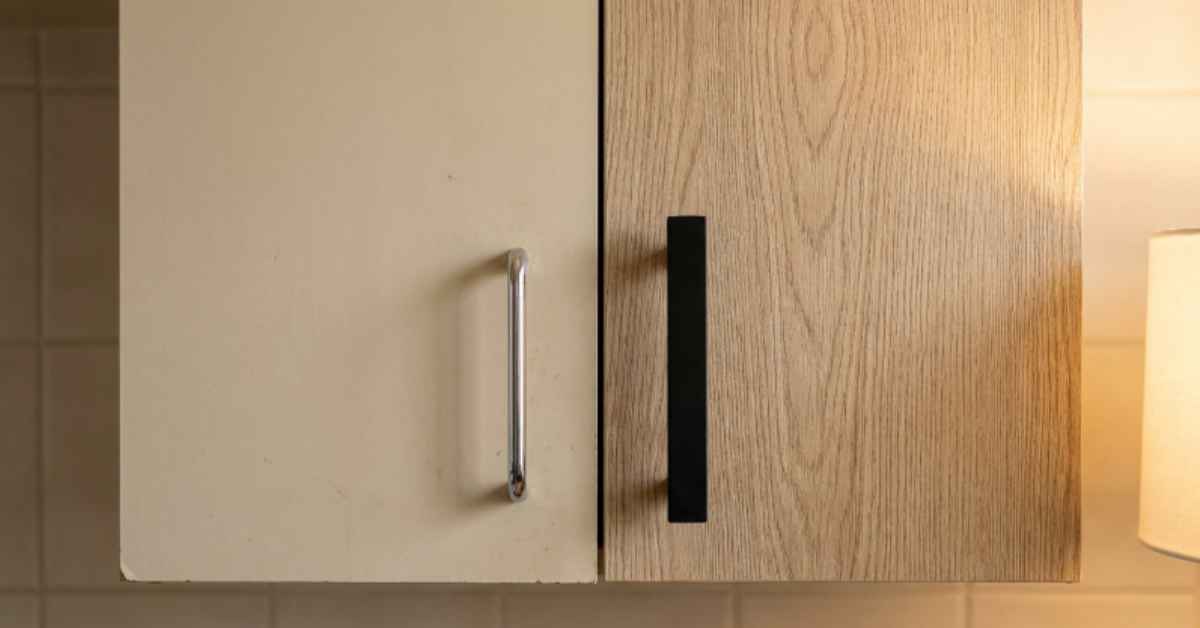
This is the most transformative, most affordable, and most renter-friendly thing you can do to a rental kitchen. Full-size adhesive sheets in warm wood grain, matte greige, or linen texture apply flat to cabinet door fronts and lift off cleanly without leaving residue.
The application process takes patience and a credit card to smooth out bubbles, but the result is a kitchen that reads as an entirely different material. For Japandi specifically, look for light oak grain, pale ash, warm greige matte, or a natural linen texture finish.
Avoid anything glossy or with a pattern, because both read as artificial in a way that works against the whole point.
Replace the hardware.
This is the single most underestimated renter-friendly change available, and most rental agreements allow it as long as you keep the originals and replace them when you leave.
Standard rental kitchen hardware tends to be chrome bar pulls, brushed nickel knobs, or the particular style of handle that appears in every rental kitchen across the country regardless of when it was fitted or what the rest of the kitchen looks like.
Swapping these for matte black bar pulls or brushed brass bar pulls costs under thirty pounds or dollars for the whole kitchen, takes about twenty minutes with a screwdriver, and changes the personality of the cabinet fronts more dramatically than most people expect before they try it.
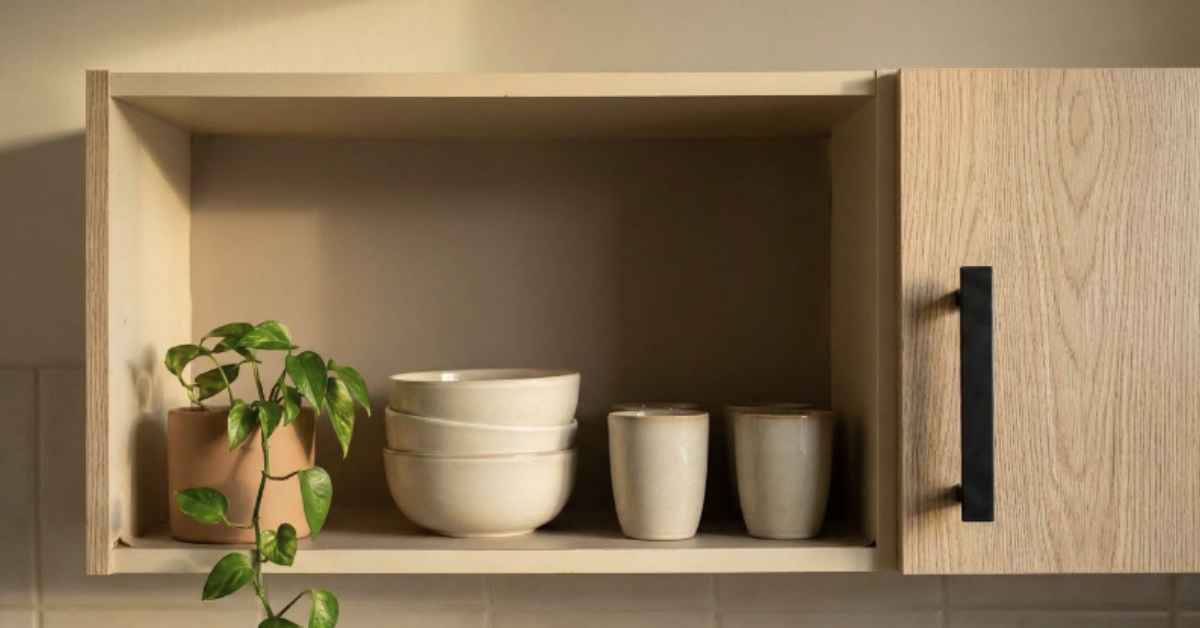
Remove the doors from one or two upper cabinets.
This sounds dramatic but is completely reversible. Take the doors off, store them safely in a wardrobe or under the bed, and line the inside back of the cabinet with a piece of warm neutral contact paper or a simple fabric panel.
Style the interior with three to five objects at most: stoneware bowls stacked neatly, a few simple cups, a small plant. This creates the open shelving look that is central to the Japandi kitchen aesthetic without any drilling, any installation, or any permanent change to the fixture. The doors go back on when you move out.
Add one freestanding or tension-mounted slim shelf on a spare wall if there is one available.
Tension-mounted shelves that press between floor and ceiling require no drilling and no damage. A single oak or bamboo shelf at eye level on a kitchen wall, styled with five objects maximum, introduces the Japandi open shelving language without any structural commitment.
Lighting Changes the Kitchen More Than Anything Else You Can Buy
Most rental kitchens have one overhead light fitting and a bulb inside it that was chosen for maximum brightness rather than any consideration of how the room would feel to be in. The result is a flat, even wash of cool white light that makes food look slightly unappetising, surfaces look harsh, and the whole kitchen feel like the kind of place where you cook quickly and then leave. Changing this costs almost nothing.
The first step is simply swapping the overhead bulb for a 2700K warm white LED. This one change, which takes about thirty seconds and costs under five pounds or dollars, transforms the visual temperature of the kitchen immediately.
The same beige cabinets, the same counter, the same tiles look noticeably warmer and more considered under a 2700K bulb than under the cool white version the landlord installed. It is one of those changes that is difficult to describe convincingly to someone who has not tried it, and immediately obvious to anyone who has.
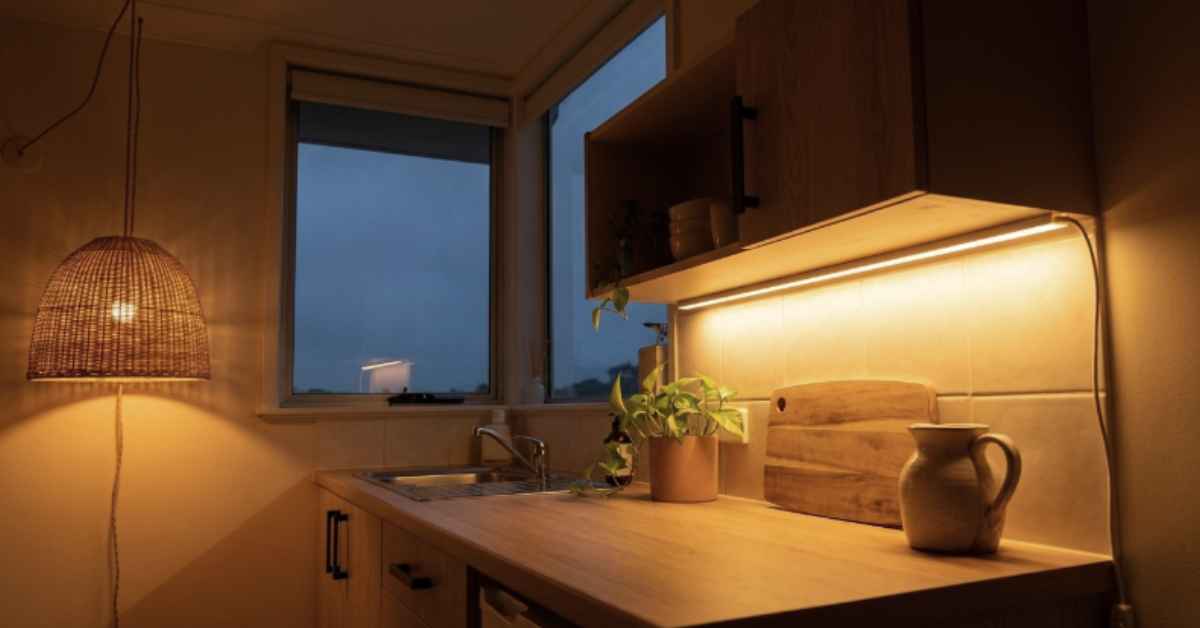
The second step is adding warm LED strip lighting under a shelf or inside a cabinet. Adhesive-backed warm LED strips peel on, plug into any socket, and require no wiring or drilling. Under-shelf lighting is one of the most recognisable features of a Japandi kitchen in any photograph you have ever admired.
That soft warm glow at counter level, coming from below a shelf rather than from above the room, is what makes a kitchen look calm and intentional rather than overhead-lit and functional. The product that creates that look costs roughly fifteen to twenty pounds or dollars.
Beyond that, if the kitchen has a table, a breakfast bar, or any surface that functions as a casual eating spot, a plug-in pendant lamp hung over it on a fabric cord completes the layered light setup. Plug-in pendant lamps with a hook and a fabric cord are widely available and entirely renter-friendly.
A rattan or woven paper shade on that cord, with a warm bulb inside, establishes the Japandi atmosphere from the top of the room downward and signals to anyone who walks in that this kitchen was thought about.
The three-source layered lighting principle, overhead warm bulb for general light, under-shelf strip for task and atmosphere, plug-in pendant for focal warmth, is what separates a kitchen that looks like a Japandi kitchen from a kitchen that looks like someone tried to make a rental nicer. All three sources warm, none of them overhead as the primary, and the overhead light used as a backup rather than the default.
The Backsplash – Renter-Friendly Ways to Soften or Hide the Wrong Tile
A bad backsplash is often the most defeating fixed feature of a rental kitchen. It is large, it is at eye level, and it tends to be the thing the eye goes to first when someone walks into the room. Fortunately, there are three approaches in order of budget and effort.
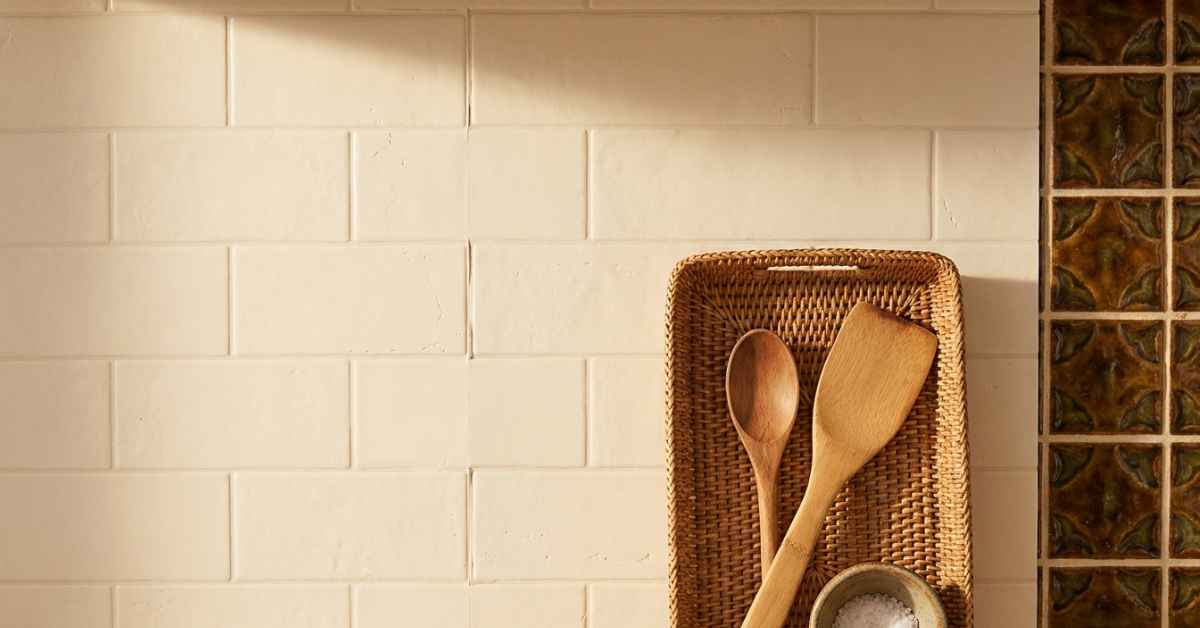
The first option is removable peel-and-stick tile panels. These are available in a wide range of finishes including Zellige-look, handmade subway tile, terracotta hexagon, and soft stone styles, and they apply directly over existing tiles without damaging the surface underneath.
For a Japandi kitchen specifically, the finishes that work best are warm cream subway in a slightly irregular finish, soft stone-look in greige or pale sand, or sage green hexagon if you want to introduce a very subtle colour note. These panels lift off cleanly and are becoming genuinely convincing at the better end of the price range.
The second option works well when the backsplash is only partially visible because open shelving or objects cover part of it. A warm-toned textured removable wallpaper or contact paper applied to the section behind a shelf changes what the eye reads as the dominant wall surface.
Because the shelf sits in front of it, the paper does not need to be perfectly applied or completely seamless. It just needs to be warm in tone and different from the tile behind it.
The third option costs almost nothing and works through distraction rather than cover. A large wooden tray or a slim wooden utensil rail mounted with adhesive command strips sits against the backsplash and introduces natural texture at exactly the point the eye would otherwise land on the tile.
The tray leans, the rail hangs, and neither requires a single hole in the wall. The eye goes to the wood and the objects on or in it rather than to the surface behind.
One additional fix worth knowing about: grout pens. If the tile itself is fine but the grout lines are dark, stained, or a colour that drags the whole backsplash down, grout paint pens restore the appearance of clean fresh grout in under an hour.
They are cheap, they are removable with acetone when you leave, and they change the cleanliness reading of the entire kitchen more than most people expect from something that costs four pounds.
The Objects and Textiles That Actually Carry the Japandi Feeling
The fittings of a rental kitchen are mostly fixed. The objects that live in it are entirely yours, and they do more visual work than any surface change. This is where the Japandi philosophy becomes genuinely accessible regardless of budget.
A linen tea towel in oat, warm cream or pale sage, folded once and hung on the oven handle, is the smallest and most effective Japandi kitchen move available. This sounds like an exaggeration. It is not.
The material quality, weight and colour of a kitchen textile sets the tone of a space in the same way a throw sets the tone of a living room. A thin polyester tea towel in a bright colour or a novelty print signals a kitchen that was not thought about.
A folded linen cloth in a warm neutral signals one that was. The cost difference between those two objects is about three pounds.
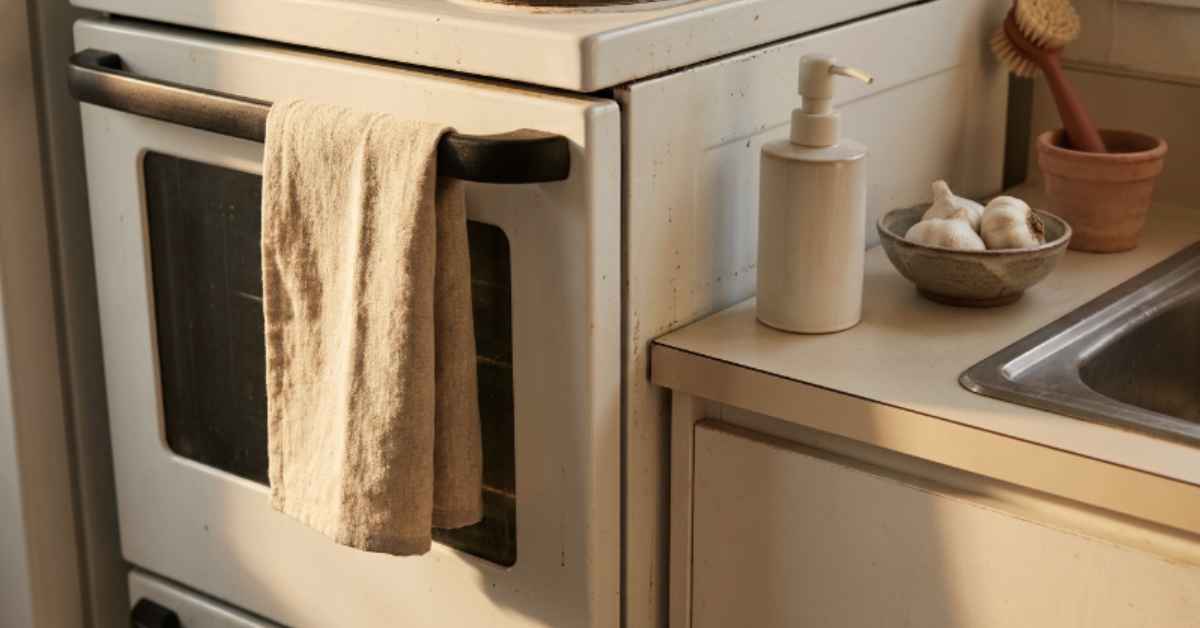
Similarly, switching visible kitchen accessories from plastic to ceramic or stoneware changes the surface reading of the whole kitchen immediately. A ceramic soap dispenser instead of a plastic pump bottle. A stoneware utensil holder instead of a plastic container.
A terracotta or matte ceramic pot for the washing-up brush instead of a suction-cup holder stuck to the sink. None of these changes cost very much individually. Together they replace the synthetic, temporary feel of a rental kitchen with something that reads as considered and lasting.
A small woven basket or rattan tray corrals loose items on the counter or on top of the fridge without adding visual noise. Because rattan and woven textures scatter light gently the way natural textures do, they make the surface they sit on feel warmer and more textured even when they are simply holding fruit or sachets or the things that have no other home.
For plants, the Japandi kitchen rule is one herb, one terracotta pot, one window. Not a collection of plants competing for the same patch of windowsill. Not a trailing plant above the sink knocking into things every time someone reaches for a glass.
One considered plant, chosen because it is useful and looks good, placed where it can actually get whatever light is available. Rosemary, basil, a small bay plant. Practical and quietly beautiful in a way that adds exactly what the Japandi philosophy asks for.
What to avoid is perhaps as useful as what to add. Matched sets of kitchen accessories in branded colours. Novelty items purchased because they were funny in the shop. Patterned dishcloths in colours that do not relate to anything else in the kitchen. Plastic storage left visible on the counter. Any object that prioritises being clever over being calm.
The Floor and the Ceiling – Two Surfaces Almost Everyone Ignores
Both of these surfaces have more potential than most renters realise, and neither requires any permanent change.
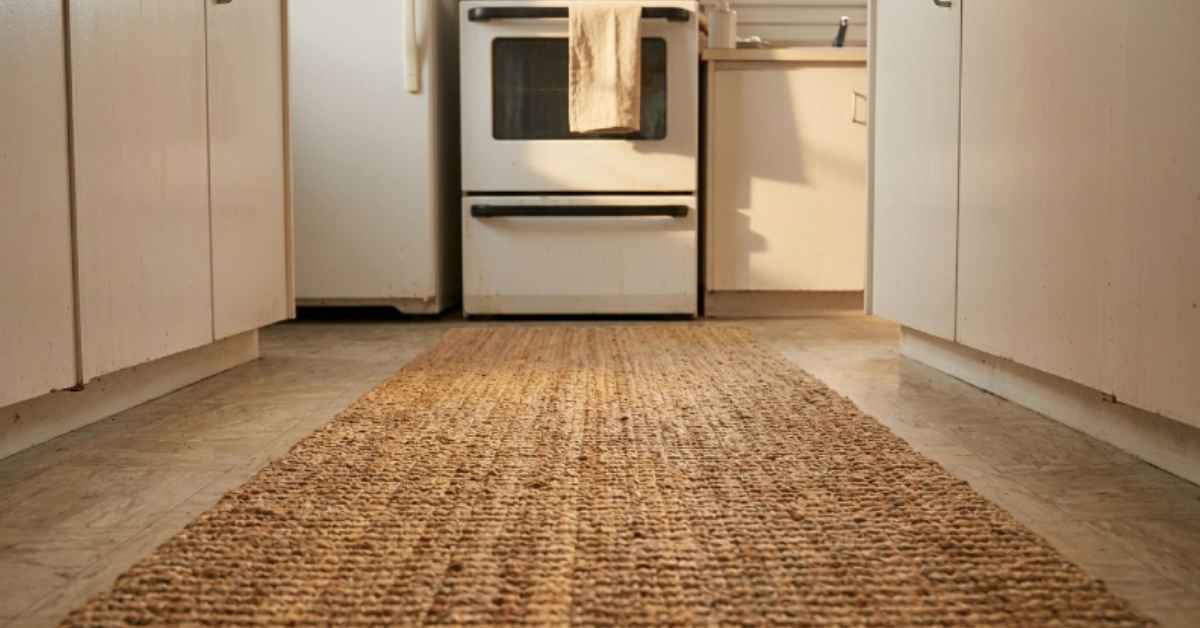
If the kitchen has enough floor space for a runner, which in most apartment kitchens means the galley aisle or the space in front of the sink and counter, a natural fibre runner in jute, flat-weave cotton, or a washable wool blend in a warm neutral tone does two things simultaneously.
It softens the floor material, which in rental kitchens is usually cold tile or vinyl, and it adds the texture layer at floor level that completes the natural material language of the kitchen.
Look for flat weave rather than deep pile because kitchen runners need to be practical and washable, and look for warm neutral tones rather than patterns because the floor should settle the room, not compete with it.
The ceiling fitting is the last thing most people think about and often the detail that holds a rental kitchen back after everything else has been addressed.
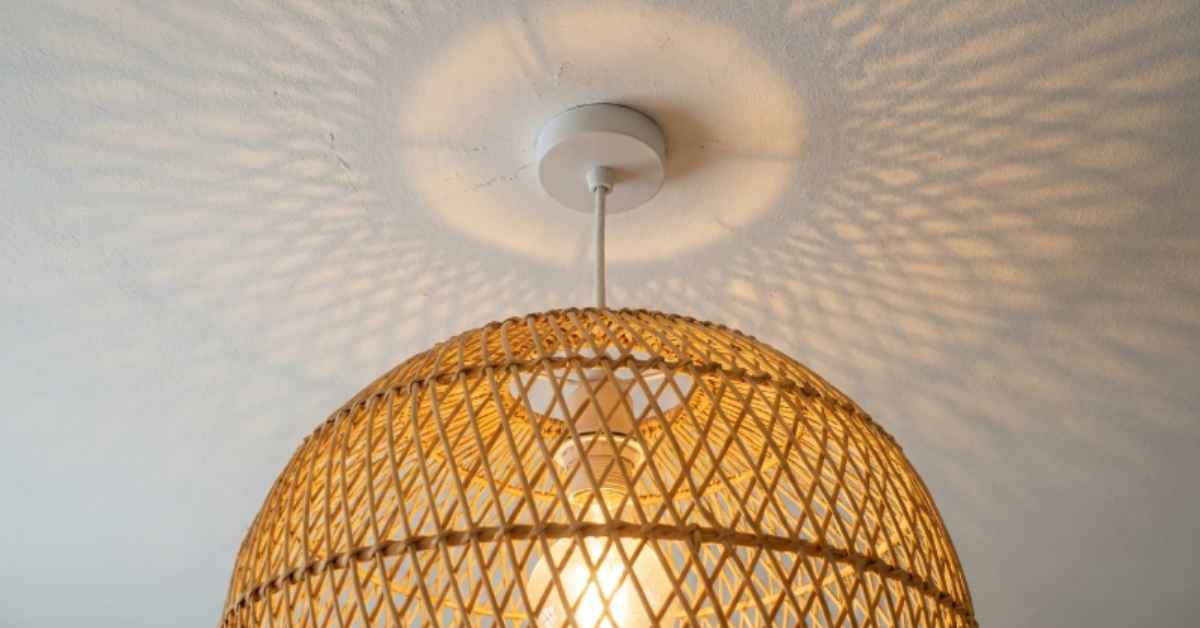
A bare bulb in a plastic fitting or a flat plastic diffuser panel reads as unfinished regardless of how good everything else in the kitchen looks. Replacing the shade with a rattan pendant or a woven paper globe costs almost nothing and changes the entire top of the room.
Many pendant shades are simply shade-only replacements that drop over an existing fitting without any wiring. If the kitchen has a bayonet or Edison screw fitting, there is almost certainly a rattan or woven paper shade designed for it that costs under twenty pounds and ships in two days.
For kitchens with fluorescent strip lighting that cannot be removed, warm-tone LED replacement tubes fit directly into existing fluorescent strip fittings and change the colour temperature without changing the fitting itself. No electrician, no permission needed, fully reversible. The fluorescent strip stays. The cold light goes.
A Calm Kitchen Is Not About What You Own
At the end of all of this, the most important thing to understand about Japandi is that it was never a design style in the sense of a set of materials to source or a look to replicate. It was always a way of thinking about the relationship between a person and the objects they choose to live with.
A rented kitchen with beige cabinet doors and a backsplash nobody would have chosen can still be a Japandi kitchen if every object on its surfaces was placed there deliberately and serves a genuine purpose.
The single most Japandi thing you can do today, before buying anything, before ordering a single item of rattan or linen or terracotta, is to take everything off every visible surface and put back only what you actually use every day.
Not what you might use. Not what you keep because it feels wasteful to move it. What you reach for daily, what earns its presence, what you would genuinely miss if it were not there.
That act of editing is the whole philosophy.
Everything else, the warm bulbs, the wooden board, the linen cloth, the terracotta pot, adds to something that already exists once the clutter is gone.
Your kitchen is where the day starts. It deserves to feel like somewhere you chose to be.
If this helped, you might also enjoy How to Make a Small Dark Apartment Feel Bigger and Brighter Without Renovation, our guide on How to Get the Japandi Look in a Small Apartment (on Any Budget) , and the Japandi Furniture Dupe List: IKEA and Amazon Pieces That Look High-End.